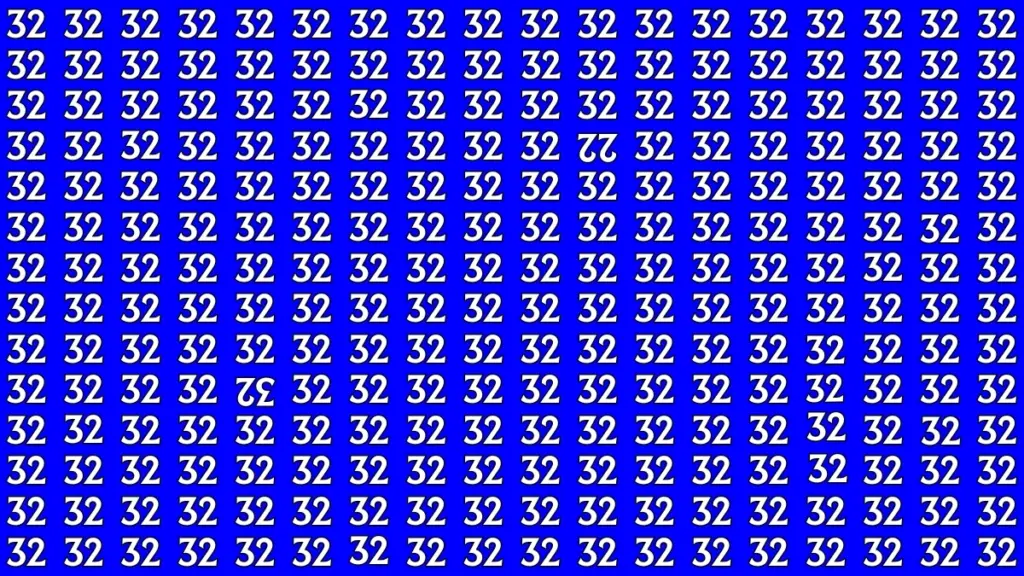
Visual illusion challenges have quietly become one of the most engaging forms of brain entertainment for Indian readers today. They are simple, quick to attempt, yet powerful enough to test focus, attention, and mental sharpness. One such trending puzzle is the Quick Illusion Challenge: Can You Detect 22 and 32 Facing the Wrong Way. At first glance, it looks like a plain number grid, but hidden inside are two numbers placed in reverse orientation that easily trick the human eye. This challenge is not just about fun; it also reveals how our brain processes patterns and familiar shapes. Many people fail on the first attempt, not because they lack intelligence, but because the mind prefers speed over accuracy.
Why optical illusion challenges attract attention
Optical illusion challenges work because they target the brain’s natural habit of shortcut thinking. When we see a group of similar numbers, our mind assumes uniformity and stops examining details carefully. In India, where mobile users enjoy short and engaging content, these challenges fit perfectly. They require no special tools, no prior knowledge, and only a few seconds of attention. Yet, they create curiosity and excitement, especially when the result is unexpected. People love to test themselves and compare their performance with friends, making such illusions highly shareable.
Understanding the illusion concept
This particular illusion plays with orientation and familiarity. Numbers like 22 and 32 are so common that the brain instantly recognizes them without checking direction. When these numbers are flipped or mirrored, the change is subtle enough to escape casual observation. The illusion does not rely on color tricks or complex shapes. Instead, it uses repetition and alignment to hide the mistake in plain sight. This makes the challenge harder than it looks and more satisfying once solved.
How the human brain processes numbers
The human brain processes numbers as symbols rather than individual lines and curves. Once a pattern is familiar, the brain stores it as a complete image. When you see many similar numbers together, your brain quickly labels them as correct and moves on. This saves time in daily life but becomes a weakness during illusion challenges. The reversed 22 and 32 break the pattern, but only slightly, which is why they are difficult to detect at first glance.
Step by step way to attempt the challenge
To improve your chances of spotting the wrong-facing numbers, slow down and scan the image row by row. Avoid jumping randomly across the grid. Focus on each digit rather than the number as a whole. Another helpful trick is to imagine how the number would look if written by hand. This mental comparison helps identify subtle orientation errors. Most people find the hidden numbers only after changing their viewing strategy.
Common mistakes people make
One of the biggest mistakes is rushing. Many users glance at the image for just a few seconds and assume there is nothing unusual. Another common error is trusting peripheral vision. The brain fills in details automatically, especially when patterns repeat. Some people also look only for color or size differences, while the real trick lies in direction. These habits make the illusion effective and challenging.
What your result says about you
If you quickly spotted both the 22 and 32 facing the wrong way, it indicates strong attention to detail and patience. It suggests that you are comfortable slowing down and questioning what you see. If you missed them on the first try, it does not mean you are weak at puzzles. It simply shows that your brain is efficient and fast, sometimes too fast for tricky visual tasks. With practice, anyone can improve performance in such challenges.
Benefits of solving illusion challenges
Regularly attempting visual illusion challenges can sharpen observation skills. They improve focus, visual memory, and mental flexibility. For Indian users who spend long hours on screens, these challenges also offer a short mental break without passive scrolling. Unlike games that require long sessions, illusion puzzles deliver satisfaction within minutes. Over time, they can even help reduce careless mistakes in daily tasks.
Why these challenges are popular on social media
Social media platforms thrive on content that sparks quick reactions. Illusion challenges do exactly that. People comment with their answers, debate difficulty, and tag friends to try. In India, where social sharing is strong, these puzzles spread rapidly across messaging apps and feeds. Their simplicity makes them accessible to all age groups, from students to working professionals.
Tips to improve your visual focus
Improving visual focus does not require complex training. Simple habits like slowing down, reducing screen brightness, and taking short breaks help a lot. Practicing puzzles that involve patterns, numbers, and shapes can also strengthen observation skills. Over time, your brain becomes more comfortable questioning first impressions instead of accepting them blindly.
Final thoughts
The Quick Illusion Challenge: Can You Detect 22 and 32 Facing the Wrong Way is more than a fun test. It is a reminder that what we see is not always what is actually there. Our brain, while powerful, can be easily fooled by familiarity and repetition. Taking a few extra seconds to observe carefully can make all the difference. Whether you solved it instantly or struggled for a while, the real win is understanding how perception works. Keep trying such challenges, not to prove intelligence, but to train awareness and patience in everyday life.